We deploy AI · We test robots · We red team AI · We train AI

Your AI gave you a number. Would you sign it?

We make AI work you can put your name under. We find where it is wrong, we build the tests that train it, and we install it in your own building, proven first in a copy of a business like yours. Every figure names the record behind it.

How we draw every figure Confirmedtwo records agree Leadan estimate or a single signal Discrepancytwo records disagree

What we do

How to start

small steps, each one useful on its own
Step 1 · free

Send us one output

One number, report or answer your AI produced, with the records it came from. We check it and show you the evidence.

Step 2 · free

Request a pilot

Tell us what you do, what software and hardware you run, and which job hurts most. The founder reads it and replies within one working day.

Step 3 · fixed price

Proof before commitment

The ten-day review of AI you already run, or your workflow proven in a test company like yours, with a scorecard. The fee credits against any build.

Step 4

Build, install, keep current

A monthly plan, a larger contract with services and updates included, or a build we hand over and step away from. Your choice.

See one working

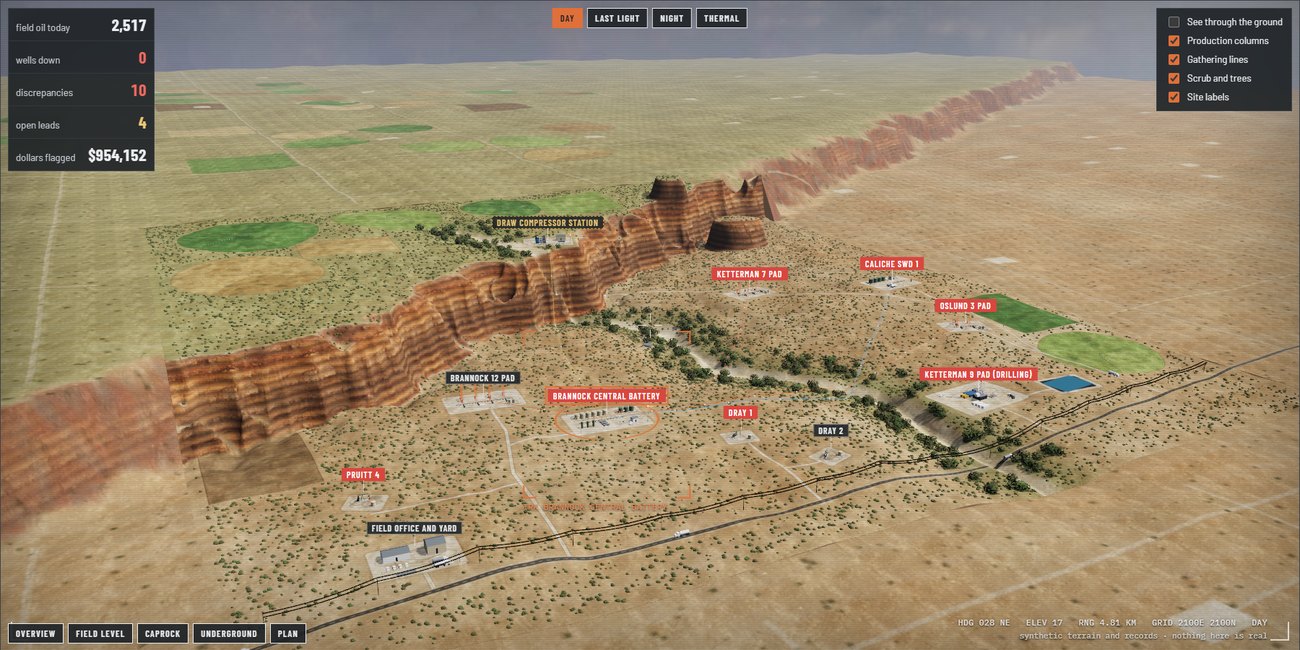
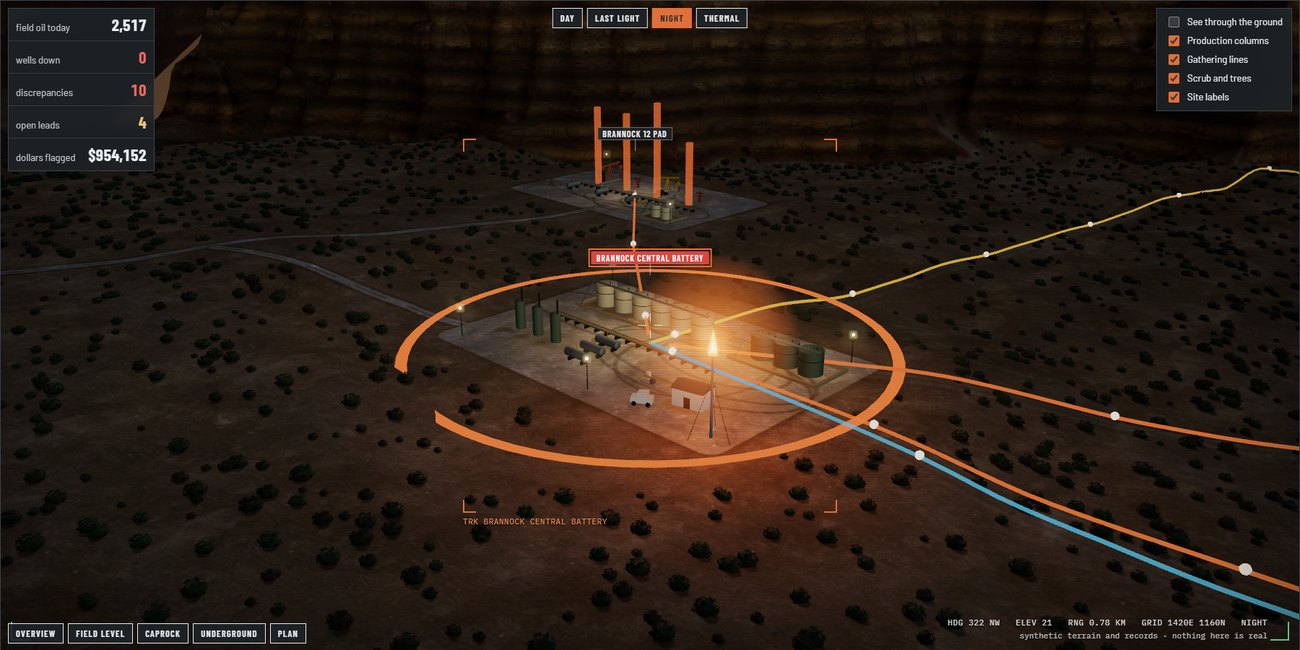
the operator pilot: an invented oil and gas company, a month of its records, fourteen planted defects · hover for night
A three dimensional oil field under a caprock escarpment with well pads, a central battery, a disposal well, a drilling rig and farmland to the horizon. A panel reads 2,517 barrels of oil today, 10 discrepancies, 4 open leads and 954,152 dollars flagged.

Everything in this scene is invented: the land, the company, the wells and every record. Sky and ground textures are CC0 from Poly Haven.

This is our test bench

A synthetic company with its own records. The ground it stands on is public terrain and aerial imagery, and the filings, grid and weather it draws on are public record. We plant defects on purpose. Any AI we build, test or train has to find them here before it goes anywhere near your records.

It keeps moving

Slide the date through the month and watch fourteen planted defects surface: a run ticket that never got paid, a haul ticket billed twice, injection pressure over the permit. Then run the replay and watch a local agent work the queue.

We build one for your trade

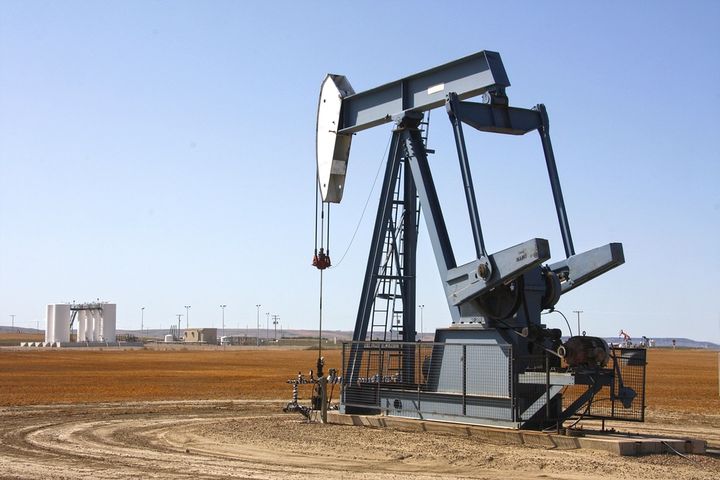
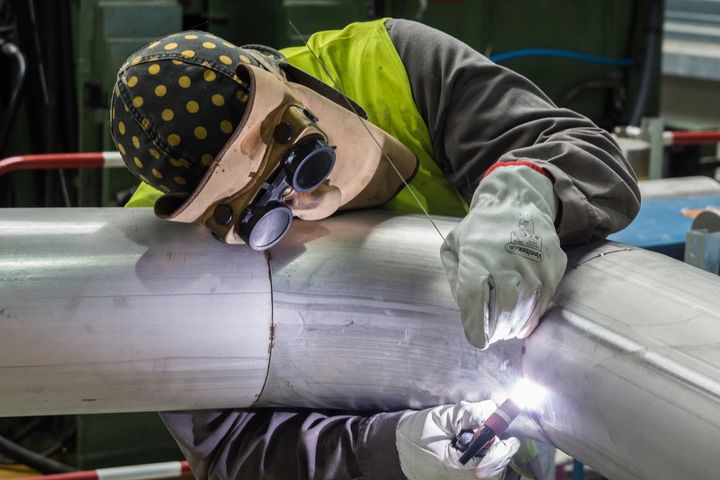
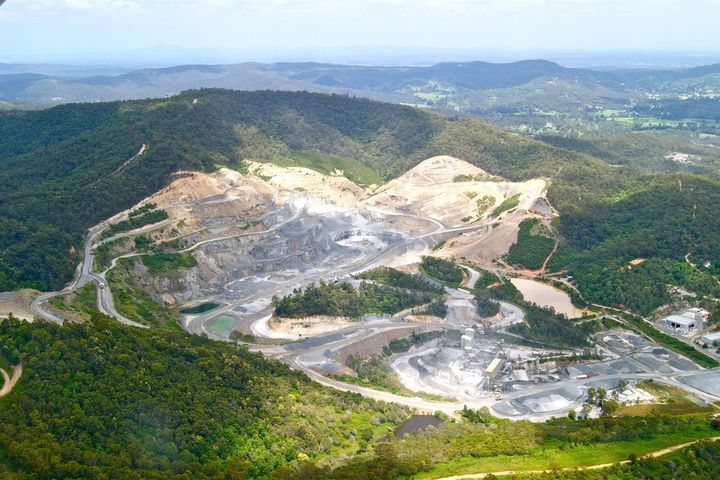
Oil and gas is the first. The same method builds a hauler, a fabrication shop, a quarry, a contractor or a clinic. If a public record exists for your industry, a test bench can stand on it.

The risk you are carrying

Fluent is not the same as right.

A model will give you a confident number with a clean explanation and no way to tell whether it read the right table, applied the right rule, or invented the threshold. The report looks finished. Someone signs it. The error surfaces at the closing, the board meeting or the deposition.

Our work on frontier-model training programs is finding exactly those failures on purpose, hundreds of times, against a written standard, and proving each one. We turn that discipline on the AI you run, the AI you are about to buy, and the AI we install for you.

The record so far

on frontier-model training programs since 2025
100s

of evaluation tasks authored for frontier AI programs, built to hold strong models below the difficulty bar

100+

task packages reviewed as a calibrated gate on frontier-model programs, each on a written record

Several

frontier-lab evaluation programs where we serve as a trusted reviewer, each verdict backed by an independent re-derivation of every quoted figure

Dozens

of validators and test fixtures in our own toolchain, each written after a check missed something

What you get in your hands

every finding names the rule, the record and the check
Defect 07Material Confidence high
OutputMonthly variance report, section 3, headline figure
RulePopulation must be the closed-period records only
FoundThe model included 41 open-period rows in a closed-period total. Headline overstated by 6.2 percent.
RecordLedger extract, period status column, 2026-08 closeledger extract > period status > closed-period population
CheckA population count against the period status column before any sum. Would have caught it in under a second.
OwnerFinance, reporting pipeline step 2

Illustrative entry. Figures shown are an example of the format, not a client result.

Where we work

if your trade leaves a public record, we can build its test bench
Small medical and chiropractic practicesLocal government and appraisal districtsCollegesSmall legal and compliance firmsAccounting and land firms

The same jobs come up in almost every one of them: matching tickets to invoices, keeping the compliance calendar, preparing the regulator's form from the ledger, assembling a bid or a data room, explaining a variance, drafting the daily report. We build each once, with a checker, and fit it to your trade.

Questions we get

Does our data leave the building?

For routine work, no. The agent runs on your hardware. When a job is too hard for the local model, it can go to the AI service you already use, on your own account, only if you allow it, under a monthly cap, with a log of every call and an off switch.

What if it is wrong?

That is the question the whole firm is built around. Every output passes a check written in plain code before a person sees it, and every figure names its record. What fails the check goes to a person, not into your books.

We already trust our AI vendor. Why have it reviewed?

Your vendor checks that the model runs. Nobody checks that the answers are right against your records and your rules. If there is no gap, the report says so, and you hold that in writing.

How much of our time does it take?

About three hours across a ten-day review: a scoping call, an hour to arrange read access and pick the sample, and the readout.

Do we need new computers?

Often not. We start by asking what you run now. Where an office computer is too slow, one small quiet box does the work. We can supply it or tell you exactly what to buy.

What happens when the models change?

We refresh the local model on a schedule. No update reaches you until it passes a test set built from your own work. If it fails, you stay on the version that works.

Do you build on a particular model?

No. We use whichever model the work needs and your accounts allow. The checking discipline is the product, and it does not depend on a vendor.

How small a company is too small?

If a wrong number would cost you money, a client or a license, you are not too small. Several of our offers are built for an office of one to ten people.

Do you work on robots?

We test them. A robot that reads a gauge or a scene wrong at full confidence is the same problem as a model that gives you a wrong number with a clean explanation. We build sealed, condition-scored tests for robot perception and for the people who supervise it. See robotics.

Do you build weapons or targeting systems?

No. Ragnarok tests and hardens the perception of autonomous systems so they read the world correctly and say when they can't. We do not build weapons or targeting systems. Our defense work is sustainment, navigation, force-protection detection and independent testing, and human judgment stays in any decision to use force.
Research

published in the open, so anyone can repeat the test
Draft for comment

Visual Reasoning Failure Modes Protocol

First edition, October 2026. 267 pages, CC BY 4.0. Nineteen ways vision-language models misread figures, documents and imagery, each with computed trap answers, a trap-free twin, a text-only control and a human fairness floor. The modes are stated hypotheses. No model has yet been scored against it. Read it on Zenodo (DOI 10.5281/zenodo.23384044).

In build

Technical series on sensor trust

Test methods for robot sensing, released as preprints as each is finished: leakage in machine-health benchmarks, a credibility method for synthetic sensor data, scoring whether a navigating robot knows it is lost, and testing the person and the robot as one team.

The team

Michigan
Nicholas DeFlumeri in a white jacket against a dark wall Nicholas DeFlumeriFounder and President

Nicholas DeFlumeri founded Ragnarok Solutions and leads every engagement. The firm adds staff to match scope and funding.

He started on the ground in energy, with rig-site support in Louisiana and fracturing support in North Texas. He then spent four years as a civilian superintendent on federal restoration and infrastructure work. After that he ran a multimillion-dollar design-build company as chief operating officer for eight years.

He is a Doctor of Chiropractic, licensed in Michigan, with twelve years in clinical neuroscience and diagnostic imaging. He taught anatomy, physiology and biomechanics at Parker University. That training in how people see and keep their balance shapes how the firm tests what robots see.

Today he authors and reviews evaluation tasks for frontier AI programs. He has written hundreds of them, serves as a trusted reviewer across several programs, and was promoted four times on review quality. He wrote the Visual Reasoning Failure Modes Protocol and built the two pilots on this site.

Real depth in trades where being wrong is expensive, and the habit of treating every AI output as a claim that needs proof.

Nicholas DeFlumeri in clinic scrubs, arms folded

Not sure where to start? Send us one output.

One report, one answer, one number your AI produced, with the records it came from. We will check it, show you the evidence, and say what would have caught it. No charge for the first one, and no obligation after it.

Robotics tile: Svan M2 quadruped by Manu amritanshu, CC BY-SA 4.0, cropped, this crop under the same license. Defense tile: Legged Squad Support System, DARPA, cropped. Insurance tile: hurricane damage in Gilchrist, Texas, FEMA photo by Jocelyn Augustino, cropped.